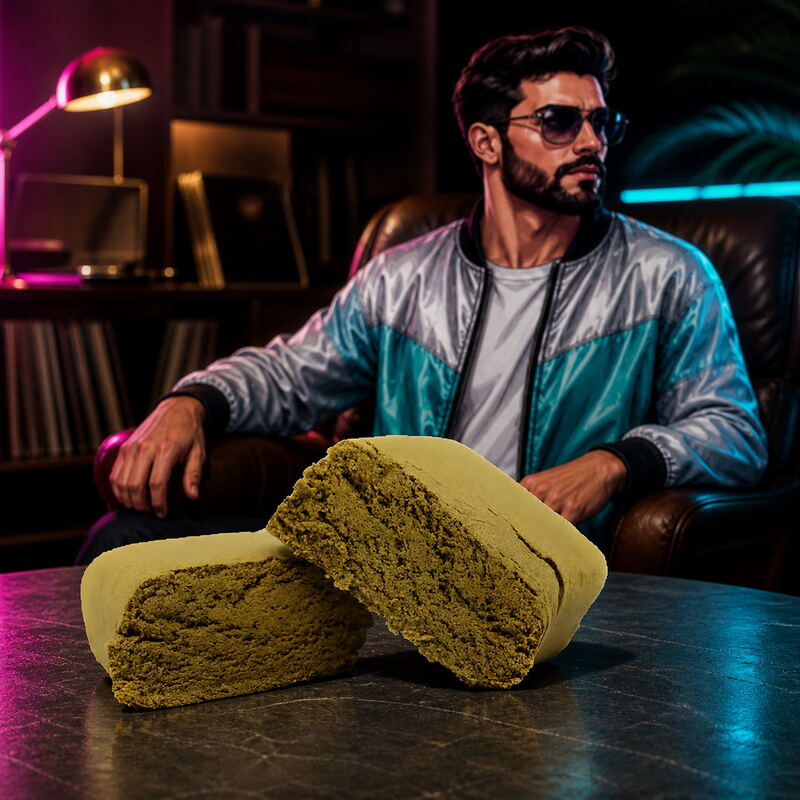
The essentials in 30 seconds: "resin", "hash" and "pollen" all refer to the same family of products — concentrates made by separating the trichomes from the hemp flower. What changes is the separation method and the degree of pressing. Pollen is unpressed trichome powder; hash is that powder pressed into a block; "resin" is the umbrella term that covers them all. None of these words, on its own, tells you how good a product is: only the raw material and the batch's lab report can do that.
The starting point: trichomes
On a hemp flower, most of the cannabinoids and terpenes aren't found in the plant material itself but in the trichomes — those translucent glands, shaped like tiny mushrooms, that cover the bracts. To the naked eye, they're the "crystals" that make a flower look frosted.
Making resin always comes down to the same basic operation: detaching these trichomes from the rest of the plant, then gathering up what you've collected. All the vocabulary on the shelf describes variations on that one operation.
The two main families of separation
Dry separation. The material is sifted through finer and finer screens. What passes through is a mix of trichome heads and fine plant particles. The finer the screen and the more passes you make, the purer the result — and the less of it there is. This is the process behind pollen and traditional dry hash.
Ice-water separation. The material is agitated in very cold water with ice: the cold makes the trichomes brittle, so they break off and are collected through a series of filters. Once dried, the result is what's known as filtered or ice-o-lator. The process is longer and more costly, and it's gentler on the terpenes — which explains the price gap.
Neither method uses any solvent. That's the dividing line worth knowing: the concentrates sold in CBD shops come from mechanical methods, either dry or with water.
Pollen, hash, filtered, pressed: which is which
| Term | What it really means |
|---|---|
| Pollen | Dry-sifted trichome powder, unpressed. Sandy texture, crumbles. |
| Hash | That same powder, pressed into a slab or ball. Firm texture, can be worked between the fingers. |
| Filtered / ice-o-lator | Trichomes separated in ice water, then dried. Often lighter in colour, more aromatic. |
| Resin | Umbrella term. Covers everything above. |
So the word "pressed" says nothing about the extraction method: a filtered can be pressed, and so can a sifted one. It only describes the final shaping.
What really makes the difference in the jar
Three things count for more than the name on the label.
The raw material. A resin can't be better than the flower it comes from. Trichomes from a carefully tended crop make a clean concentrate; mediocre material makes a dull product, whatever the process.
The yield being chased. The more material you try to recover, the more plant matter comes along with the trichomes. A producer aiming for volume turns out a greener, drier product; one who sorts ruthlessly turns out less product, but more consistent.
Freshness. Terpenes are volatile. Resin kept away from light, heat and air holds on to its aromatic profile; left exposed, it fades within a few weeks.
And the regulations?
In France, the same rules apply as for flowers: the product must come from authorised hemp varieties and contain no more than 0.3% THC. Sales are restricted to adults, no therapeutic claims are allowed, and the product is not intended to be smoked.
A serious seller makes the lab report for the batch you're buying available — not a generic report for the whole range. It's the only document that actually holds someone accountable. The legal framework is explained in detail in our article CBD and French law.
FAQ
Is CBD hash stronger than flower?
A concentrate is, by definition, richer than the flower it comes from, since the trichomes have been gathered together in it. But "stronger" doesn't mean much without the batch's lab report: two resins of the same type can be very far apart. It's the analysis that counts, not the product category.
What's the difference between pollen and hash?
Pressing, and nothing else. Pollen is trichome powder sifted and left as it is; hash is that same powder pressed into a block. Same material, two formats.
Why does filtered cost more?
Because ice-water separation takes more raw material, more time and more water for a lower yield, and because it preserves the terpenes better. The extra cost comes from production, not from marketing.
How should I store resin?
Away from light, heat and moisture, in an airtight container, out of the reach of children. Terpenes are volatile: it's exposure to air and heat that wears a concentrate down, far more than the passing of time.
How do I know what I'm buying?
By reading the batch label and its lab report: strain, batch number, net weight, and the matching analysis from the independent laboratory. You'll find our full selection on the CBD resins page, and the reinforced range on CBDX resins.